
Groundhog Diplomacy
Trump keeps threatening Iran, cancelling himself, and announcing the future as though reality is obliged to catch up

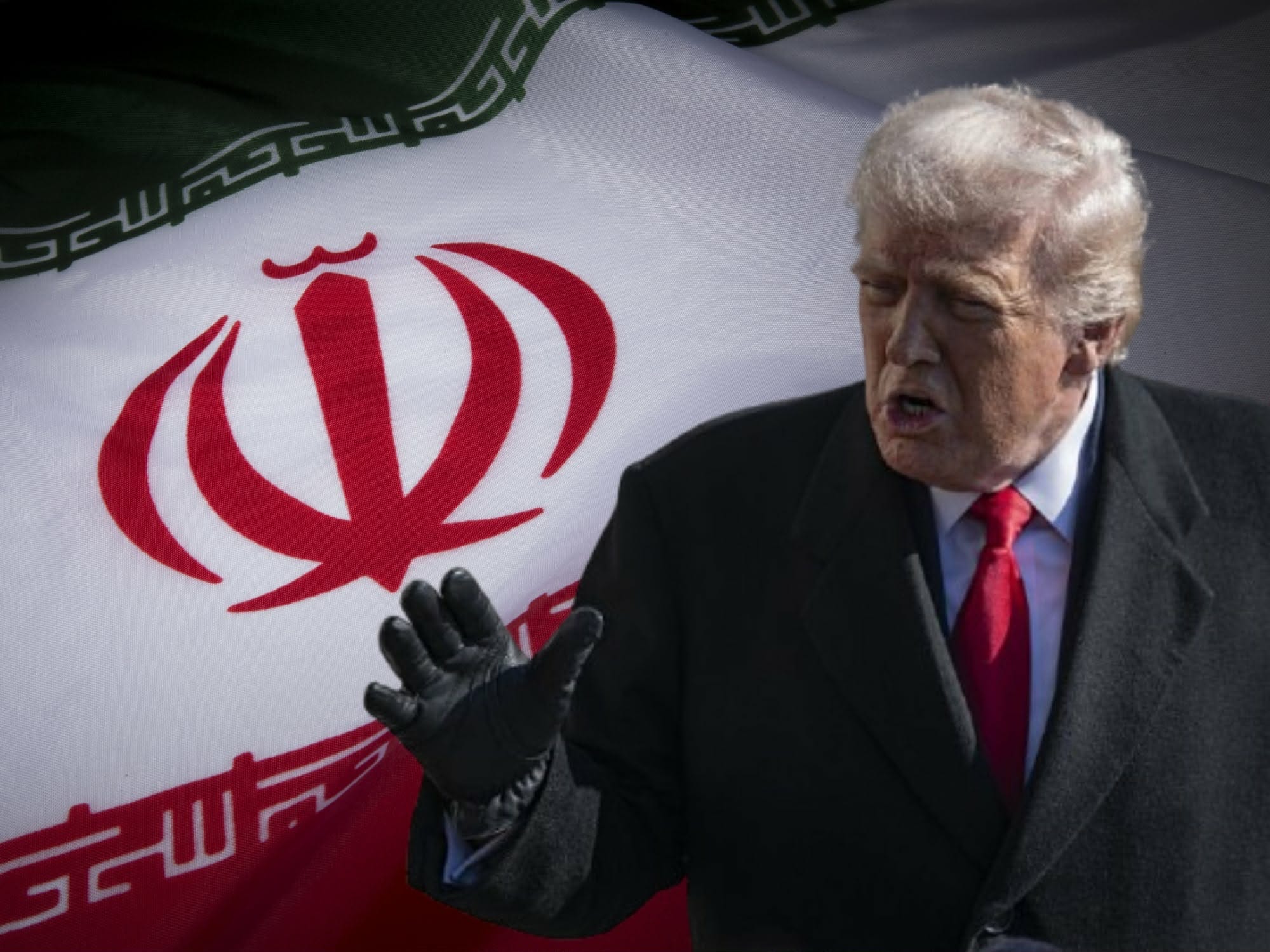
Donald Trump has once again threatened Iran, reached for the language of catastrophic destruction, watched the world tense up before markets opened, and then pivoted back towards diplomacy with the theatrical timing of a man trying to defuse a bomb he personally brought to dinner.
This is why I have not written about every lurch in the Iran saga. There are only so many times one can write “Trump threatens escalation, Trump hints at deal, Trump declares victory, Trump backs away, Trump blames someone else, Trump threatens escalation again” before the keyboard starts filing a workplace injury claim.
At some point, the story stops being the individual threat.
The story becomes the loop.
Or, more accurately, the Groundhog Diplomacy.
Every few days, Trump wakes up in the same foreign-policy morning. The alarm goes off. The television is shouting. Someone is telling him to be strong. Someone else is telling him oil markets are about to go through the ceiling. A hawk wants escalation. A dealmaker wants talks. A regional ally wants cover. A strategist wants leverage. The markets want oxygen. The Pentagon wants clarity. Iran wants time. Trump wants a “beautiful deal” he can announce in capital letters.
Then the music starts again.
Threat > Panic > Walk-back > Negotiation > Victory claim > No actual settlement > Repeat until morale improves.
The latest fits the pattern. Trump has repeatedly threatened renewed attacks on Iran, including warning that Iran needed to move fast “or there won’t be anything left”, before saying he had called off a planned attack to give negotiations more time after pressure from Middle Eastern leaders. Trump also said he had instructed military leaders not to carry out the scheduled strike, while insisting the United States remained ready for a large-scale assault if talks failed.
That is not strategy so much as strategic weather.
It changes every few hours, but everyone still has to pack an umbrella.
The deal that exists in Trump’s head
Trump’s negotiating style has always had a strange relationship with sequence. Most leaders negotiate a deal, confirm the parties accept it, then announce the deal. Trump often appears to prefer announcing the idealised version first and hoping reality feels embarrassed enough to comply.
It is diplomacy by manifestation.
He did something similar with Hamas disarmament. Trump suggested he had received assurances that Hamas would disarm, but the Washington Post reported that Hamas had not publicly agreed to or signed anything specifying how it would do so. More recent reporting has suggested his broader disarmament and withdrawal plan has already run into trouble, with Israel and Hamas not aligned on core terms.
This is classic Trump.
Announce the future.
Wait for everyone else to rearrange reality around the announcement.
If they do not, accuse them of bad faith.
It is not entirely irrational. There is a crude logic to it. Publicly declaring that someone has agreed to something can be a form of pressure. It can create a headline. It can create expectations. It can attempt to shame the other side into accepting a frame they have not actually accepted. It turns diplomacy into a stage trick: if enough people clap, perhaps the rabbit will appear.
But international politics is rude like that.
Sometimes the rabbit remains stubbornly absent.
Iran, in particular, does not seem interested in helping Trump turn his preferred press release into reality. From the available reporting, Tehran appears to believe it is in a stronger position than Washington expected. Iran has resisted American terms around enrichment, sanctions sequencing and broader regional concessions. It has also used the Strait of Hormuz standoff to remind everyone that it still holds a nasty little lever over global energy markets. The Associated Press reported that the Strait of Hormuz remains central to negotiations, with about a fifth of the world’s traded oil previously passing through it.
That is the part Trump seems to hate.
He wants surrender dressed as a deal.
Iran appears to want him to discover that bombing a regime does not automatically produce a grateful negotiating partner with a souvenir pen.
The regime-change ghost
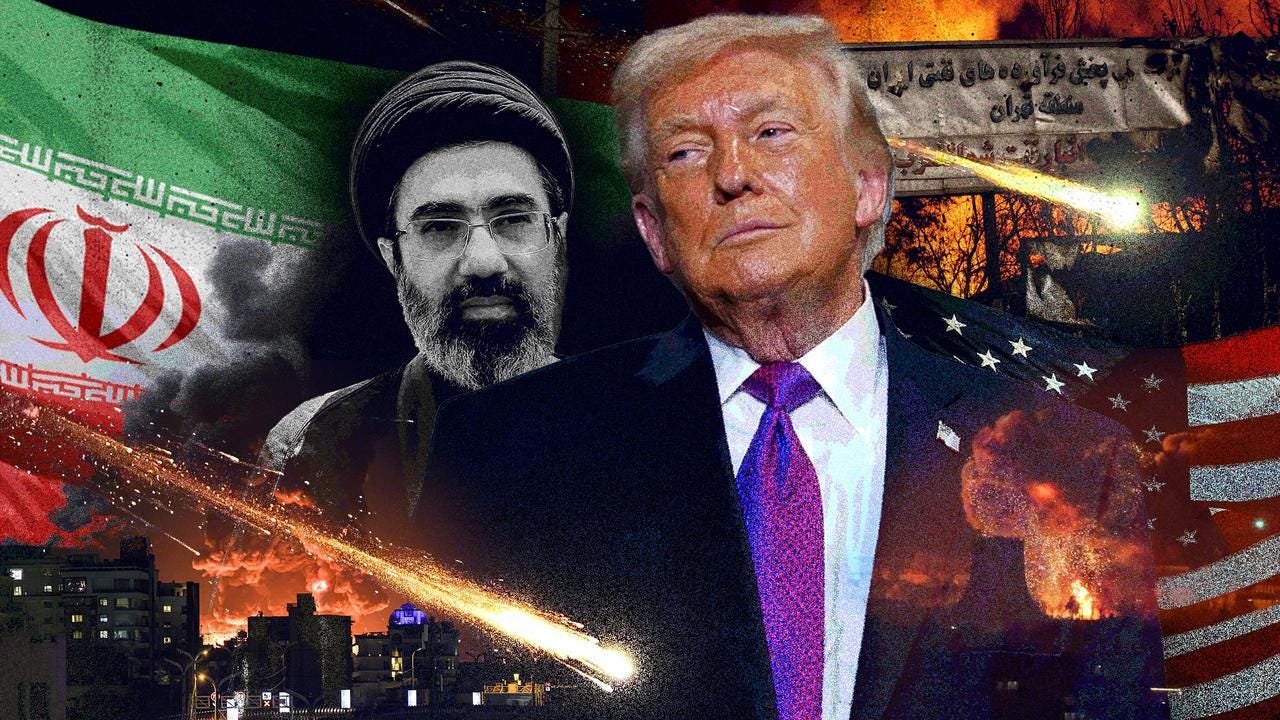
This appears to have started, at least in ambition, as something much larger than a limited coercive campaign. The United States and Israel launched attacks on Iran with goals including regime change in Tehran and dismantling Iran’s nuclear program. Since then, the conflict has dragged into a prolonged confrontation around the Strait of Hormuz, sanctions, blockades, nuclear limits and maritime access.
That original ambition is important to reflect on.
The current diplomatic muddle makes more sense if you understand it as a regime-change campaign that did not produce the regime change quickly enough.
The fantasy was probably familiar: hit hard, degrade the regime, create pressure, wait for cracks, then negotiate with whatever is left. A neat little sequence. Very satisfying on a whiteboard. The old imperial dream of creating a new political reality through enough explosives and a strongly worded statement.
But Iran is not a cardboard cut-out. It is a state with institutions, coercive capacity, nationalist reflexes, regional networks, asymmetric tools and a long memory of foreign interference. Its leaders are brutal, corrupt and repressive, but that does not mean they are stupid. They understand Trump’s need for a win. They understand America’s domestic fatigue. They understand oil-market anxiety. They understand that the longer they survive, the more the original American promise starts to curdle.
Trump’s problem is that he wants the benefits of regime change without the sustained campaign required to attempt it, and the benefits of diplomacy without the concessions required to achieve it.
That leaves him trapped between theatre and reality.
He can threaten destruction. He can delay destruction. He can announce progress. He can hint at a breakthrough. He can insist the deal is close. But he cannot simply tweet Iran into accepting the ending he has already written.
Iran smells weakness, or at least impatience
The striking thing about Iran’s posture is not merely that it refuses to accept Trump’s terms. It is that it appears willing to make him sit with the refusal.
Iran does not need to defeat the United States in any traditional military sense. It cannot. The United States remains vastly more powerful. The question is not whether Iran can win a conventional war against America. It obviously cannot.
The question is whether Iran can make the price of American success higher than Trump is willing to pay.
A weaker power does not always need victory. Sometimes it needs endurance. It needs to survive the opening shock, impose costs, create uncertainty, hold a strategic chokepoint at risk, wait for domestic divisions inside the stronger power, and force the superpower to explain why the quick clean campaign is now a grinding political problem.
That appears to be where Trump now finds himself.
He has factions tugging at him in different directions. Hawks want punishment. Dealmakers want an announcement. Markets want stability. His base is not naturally enthusiastic about another open-ended Middle Eastern war. Regional partners want Iran contained but not necessarily a general firestorm. The military can provide options, but not magic. There is a strain on American munitions and broader uncertainty around what renewed strikes would achieve.
This is why Iran may feel stronger than expected.
Not stronger than America.
Stronger than Trump’s attention span.
The Lyndon Johnson problem
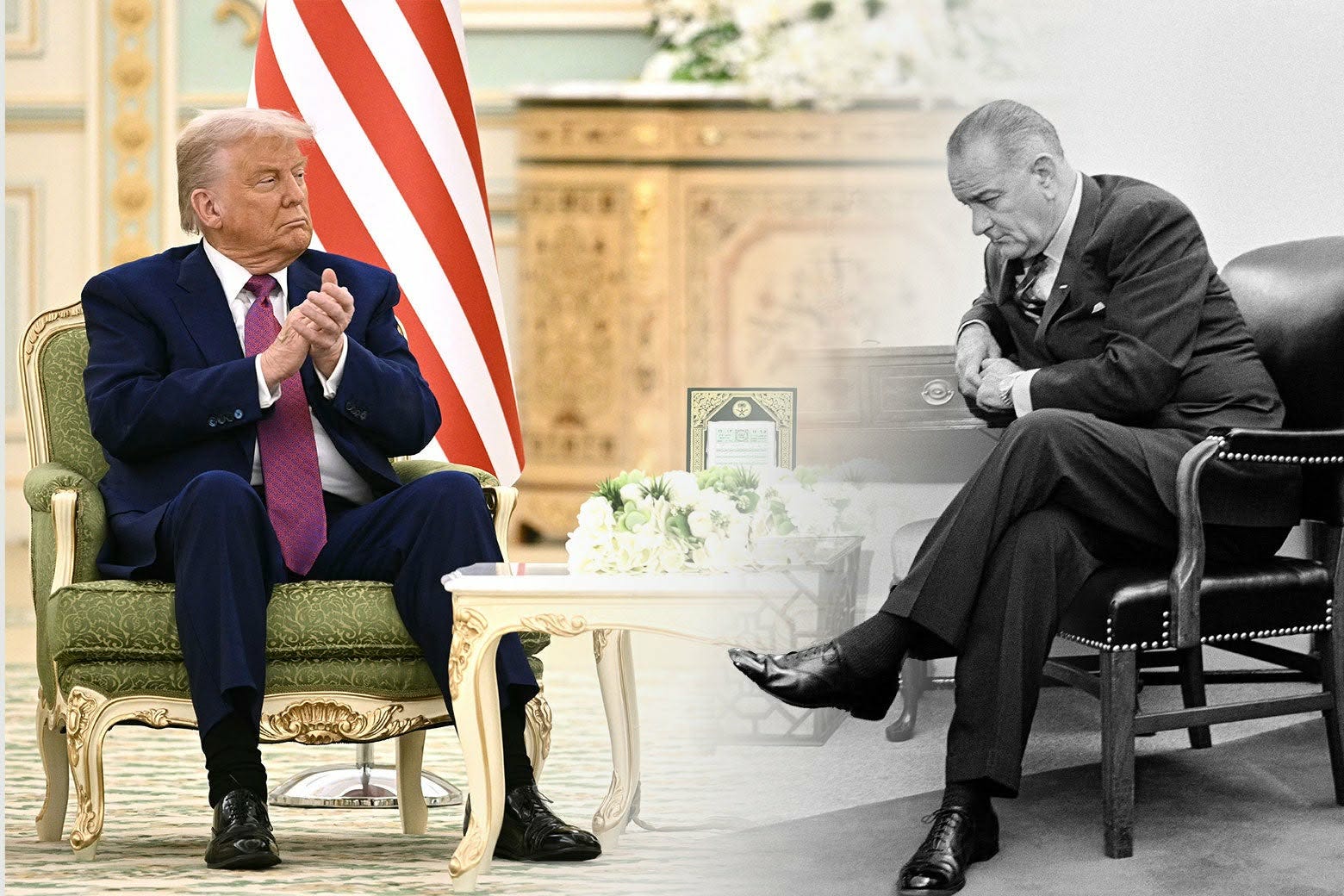
This is where the historical analogy starts clearing its throat.
Trump is not Lyndon Johnson. Iran is not Vietnam. History is not a photocopier with napalm and a red tie. The analogy is not exact, but there is a Johnson-shaped problem here.
Lyndon Johnson inherited a conflict he did not really want to define his presidency, then escalated because withdrawal looked like weakness, stalemate looked like humiliation, and victory seemed always just one more application of force away. Johnson kept insisting he did not seek a wider war even as the machinery of escalation pulled him deeper. In 1964, Johnson said the United States sought “no wider war” in Vietnam; by 1965, the United States had begun sustained bombing and moved into an open-ended military commitment.
That is the danger.
Not that Trump is about to recreate Vietnam in Iran. He almost certainly does not have the patience, ideology, bureaucratic discipline or domestic support for a long, grinding campaign aimed at remaking Iran by force. He does not seem built for Lyndon Johnson’s tragedy. He is built for something shallower and more televisual: threat, spectacle, announcement, applause, exit ramp.
But the trap has a family resemblance.
A president wants to appear strong. A smaller adversary refuses to fold. Military action produces damage but not settlement. Negotiations stall because the original goals are too maximalist. Domestic politics punishes weakness. Allies apply pressure. Hawks demand escalation. Markets punish uncertainty. The president keeps insisting victory or a good deal is near because admitting otherwise would mean admitting the whole thing has become something he cannot control.
Johnson’s tragedy was escalation into ownership.
Trump’s risk is humiliation through oscillation.
Johnson became trapped in a war he could not win at a price America would pay.
Trump is trapped in a confrontation he cannot end on terms grand enough to match his own speeches.
The art of announcing things that have not happened
Trump’s great weakness in diplomacy is that he confuses announcement with achievement.
In domestic politics, this can work for a while. Announce the wall. Announce the deal. Announce the crackdown. Announce the victory. The base hears the music. The details can be handled later, or not at all.
But foreign adversaries are not rally crowds.
They do not have to chant along.
Hamas does not disarm because Trump says it has agreed to disarm. Iran does not accept a nuclear settlement because Trump declares the terms obvious. The Strait of Hormuz does not reopen because someone’s press team found the phrase “major breakthrough”. A war does not end because the president is tired of it being politically inconvenient.
Reality has a tedious habit of asking follow-up questions.
Who controls the inspections?
What happens to enrichment?
Which sanctions lift first?
Who guarantees the deal?
Who verifies compliance?
Who pays the political cost?
Who gets to claim victory?
This is where the Trump method struggles. It is built for the reveal, not the implementation. It wants the signing ceremony before the negotiation. It wants the headline before the concession. It wants the victory lap while the race is still arguing about the starting gun.
The loop continues

So here we are again.
Threats. Talks. Markets. Signals. Walk-backs. Rumours of deals. Denials. Leaks. Briefings. Strongman language. Diplomatic reality. The Groundhog Diplomacy continues.
Trump wants the world to behave like one of his property negotiations: make the threat, dominate the room, declare the number, force the other side to blink.
Iran is not blinking on schedule.
That is the problem.
The United States can still do enormous damage. It can strike. It can blockade. It can sanction. It can isolate. It can degrade Iranian capacity. It can make life much harder for Tehran.
But turning damage into political settlement is the hard part.
That is what Trump keeps trying to skip.
And that is why this all feels so strange. Not because he threatens Iran. American presidents have threatened Iran before. Not because Iran refuses American pressure. Iran has done that for decades. Not because diplomacy is messy. Diplomacy is usually a compost heap in formalwear.
It feels strange because Trump keeps announcing the ending before the plot has agreed to move.
He speaks in conclusions.
The world replies in complications.
That is the loop.
And until someone finds a way to turn Trump’s idealised future into actual negotiated terms, he will keep waking up in the same foreign-policy morning, threatening destruction before breakfast and discovering diplomacy before the markets open.
Groundhog Diplomacy.
Same threat.
Same walk-back.
Same search for a deal that may not be there.
And somewhere in Tehran, one suspects, they have noticed.
Thanks for reading this one.
I mostly wrote it because the Iran story has reached the point where each individual Trump threat feels less like a fresh development and more like another lap around the same diplomatic roundabout.
Threaten destruction. Hint at a deal. Announce a future that has not quite happened. Walk it back. Blame the other side. Repeat until the markets stop twitching.
As always, I appreciate you reading, sharing and supporting the work. It helps keep the Gherkin in the brine while world leaders continue trying to conduct foreign policy with a fog machine, a stopwatch and several deeply unhelpful advisers.
Cheers.
This has been the dumbest war in modern history started by the dumbest president and dumbest secretary of defence and a foreign leader whose interest is so narrow and self defeating whom did not care if the rest of the world suffered on unrealistic pretence and aims that were never going to be achieved because since the 1970’s this has been war gamed out that it would go exactly like this.
Trump doesn’t understand modern Iran or the revolution that underpinned it, Hegseth is a Christian end times crusader moron, Netanyahu is a psychopath and of course we are all stuck in this endless game on nonsense being conducted by the worlds biggest bull shitter and grifter.
Now America is losing influence in the Middle East see the new Türkiye, Pakistan, Saudi joint nato like arrangement, I suspect is more a counter to Israel than Iran.
And Israel is becoming more and more isolated.
Iran is becoming a power centre in the Middle East with its control over the strait with Oman to come, which was OPEN, before all this nonsense.
It is purely a war of choice not of necessity, Iran didn’t have a bomb but sure as hell will get one someday, because the only way to deter America these days is to have one.
(Notice trump does nothing about North Korea).
All while fertilisers, oil, gas, hydrogen have all been restricted globally and trump plays the markets for his own financial gain.
We truly are living in the dumbest times in human history.
Iran’s position: they don’t negotiate with terrorists.
Pure and simple.